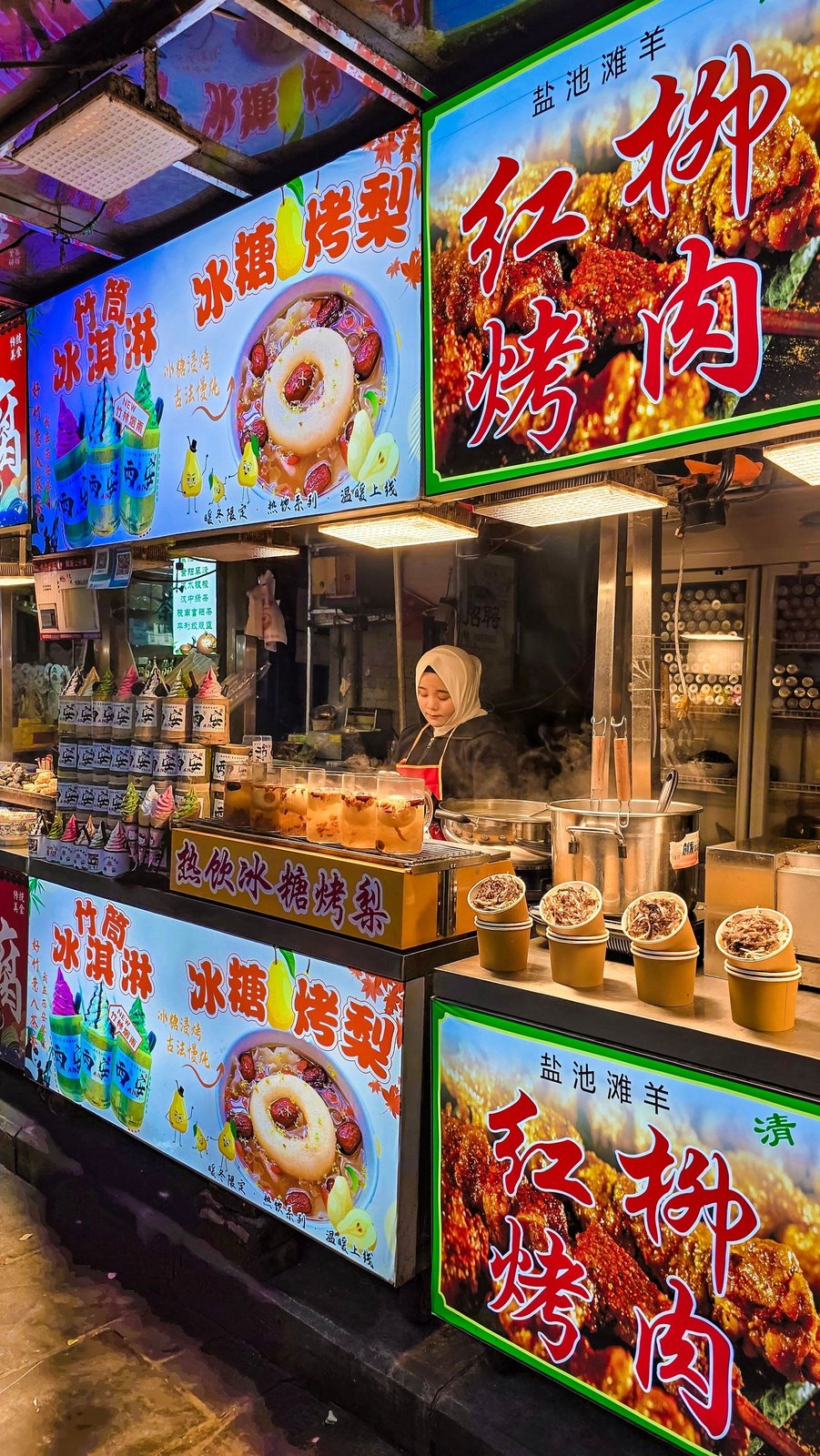
Muslim Quarter
The main street is a visitor strip; the good food is one lane over. Walk past the souvenirs to Shajinqiao and Dapiyuan, where Xi'an actually eats.
Rated for foreign travellers
Six things overseas visitors weigh most in China, scored 1 to 5. Based on what travellers actually ask about before they come.
- SafetyHow safe it feels
- 4.6
- Getting thereTransit convenience
- 4.9
- EnglishEnglish signs & staff
- 3.3
- PaymentsEasy to pay
- 4.8
- CleanClean & comfortable
- 3.8
- ValueWorth the money
- 4.5
The Muslim Quarter exists because Tang dynasty traders settled here and stayed. That is a thousand years of layering, and it is visible if you look past the neon and the souvenir stalls: the lane grid, the mosque courtyards, the butchers’ shops that have been in the same families for generations.
Forget the main street
Beiyuanmen is the broad pedestrian street you will be dropped on, lined with identical shops and men waving skewers. It is fine for a first look but it is not where Xi’an eats. Two moves fix it. Turn east into Dapiyuan, a narrower lane packed with small shops and queues of locals. Or walk west about ten minutes to Shajinqiao, which is a breakfast street first and a tourist sight second.
The difference is immediate. Prices drop, the portions look less arranged, and the smell of baking flatbread replaces the smell of frying oil. This is where a plate of roujiamo costs ¥10–15 (about $1.4–2.1) and where a bowl of yangrou paomo is ¥25–35 (about $3.6–5).
The food, in order
Start with a roujiamo — chopped braised pork in a white wheat bun, and insist the bun is fresh from the oven. Then sit down to yangrou paomo. You get a flatbread and a bowl of mutton broth; tear the bread into small pieces, the finer the better, and the kitchen finishes it. It is a ritual as much as a meal, served with sweet garlic and chili paste.
Biangbiang noodles are belt-wide and arrive under a spoonful of hot chili oil. Zenggao is a dense cake of sticky rice and red dates, sold in the morning and sweet enough to count as breakfast. Wash it down with a sour plum drink, ¥8–12 (about $1.1–1.7), cold and tart. Meatball hulatang is the winter option — peppery, thickened beef broth with bread to dunk.
The mosque most people miss
Off Huajue Lane stands the Great Mosque, founded in 742 AD and one of the oldest in China. What surprises people is the architecture: it is a series of Chinese courtyard gardens with wooden pavilions and a minaret that reads like a pagoda. It is a working mosque with a long history, not a photo stop, so dress and behave accordingly. There is an entry charge and the hours should be checked on site.
Practical notes
The whole area is a few minutes’ walk north of the Bell Tower and is best explored on foot. Go in the morning for breakfast, or in the early evening when the stalls are busy but not yet shoulder-to-shoulder. Late evening gets crowded and the better shops start selling out.
Prices are low and cashless payment is universal. Ask before ordering if there is a seat charge, and expect queues at the well-known shops — a shop with a shorter line one door down is often just as good. The lane around Shajinqiao is the local morning market; by nine much of it is done, so go early if that is the point of your visit.
Before you go
Is it a tourist trap?
Partly. Beiyuanmen, the main street, is set up for visitors and priced accordingly. Turn into Dapiyuan or walk a few minutes west to Shajinqiao and both the food and the prices change immediately.
What should I eat first?
A roujiamo, ¥10–15 (about $1.4–2.1), with the bun straight from the oven. Then a bowl of yangrou paomo, ¥25–35 (about $3.6–5), which you crumble yourself. Zenggao and a sour plum drink are easy additions.
Is the Great Mosque worth visiting?
Yes, and most people walk past it. It sits off Huajue Lane, dates to 742 AD, and is a Chinese courtyard mosque rather than a Middle Eastern-style building. Entry is charged; check the current price and hours on site.
More in Xi'an
Want a plan that fits your dates?
Tell us your dates, budget and what you actually like doing — we will send back a day-by-day plan by email. No charge for the first draft.
Plan with us →